
 Login
Login


AI in ecommerce is no longer limited to chatbots or product-description tools. It can help shoppers discover products, understand complex requests, analyze store data, create content, recommend products, and support store operations.
The bigger shift in 2026 is the move from generative AI to agentic AI. While generative AI creates content when prompted, AI agents can understand goals, determine the required steps, interact with ecommerce systems, and take action.
This is bringing AI closer to the actual transaction. In January 2026, Google introduced the Universal Commerce Protocol (UCP), designed to connect AI agents, retailers, payment providers, and platforms across discovery, purchase, and post-purchase experiences.
This guide explores what AI means for ecommerce businesses.
What Is AI in Ecommerce?

AI in ecommerce is the use of artificial intelligence to improve, automate, or assist online shopping and store operations.
It can power product search, recommendations, content creation, customer support, sales analysis, personalization, and AI agents.
In simple terms, AI can help shoppers find products and merchants run their stores more efficiently.
Traditional Automation vs AI
Traditional automation follows predefined rules.
If the order exceeds $100, offer free shipping. AI can handle less structured requests by interpreting context.
“Find comfortable black shoes for commuting in heavy rain.”
Instead of matching a single filter, AI can understand factors such as comfort, color, waterproofing, and intended use.
The Main Types of AI in Ecommerce
Several types of AI are commonly used in ecommerce:
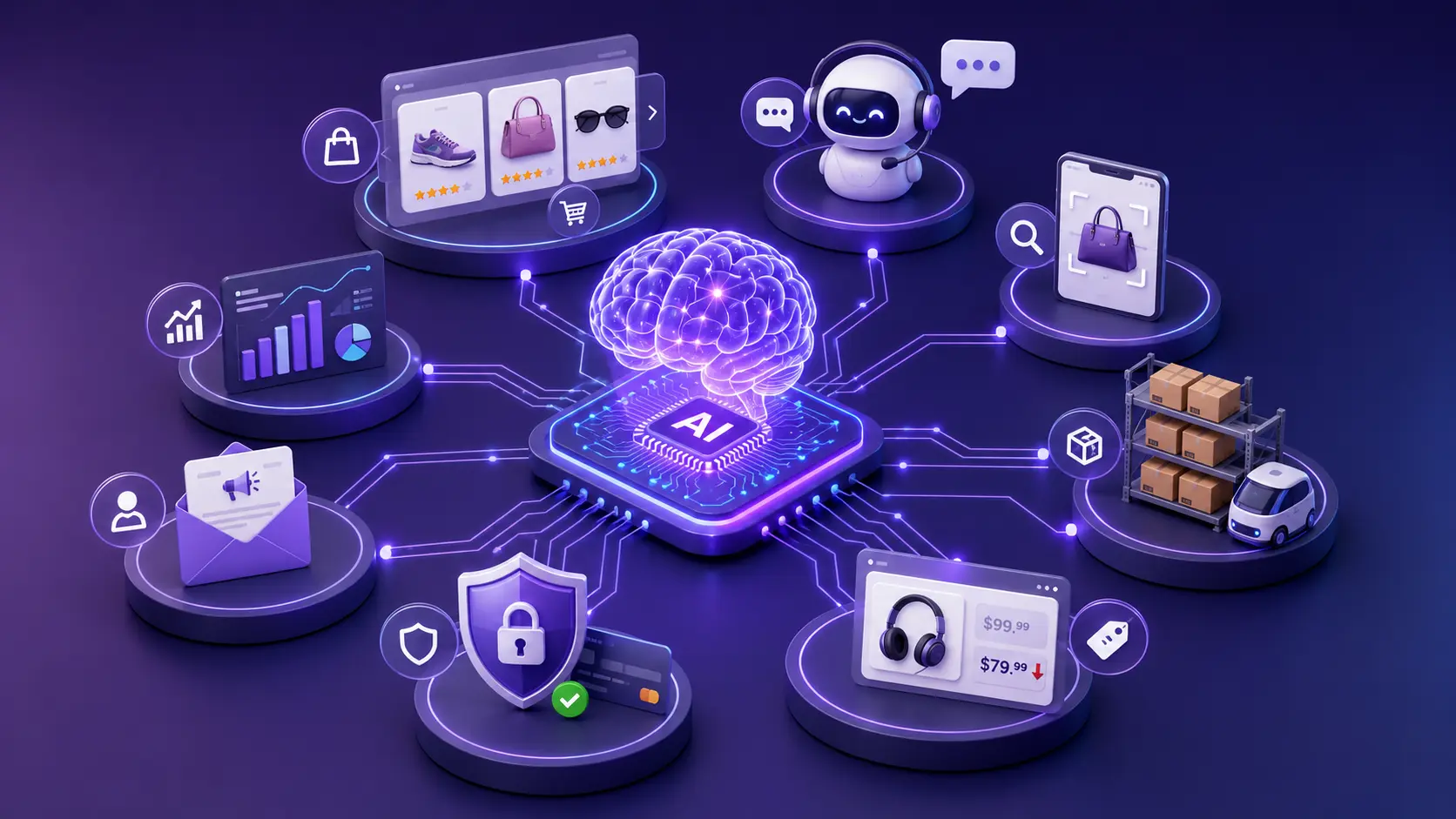
(i) Predictive AI analyzes historical information to estimate what may happen next, such as customer churn, demand, or purchase likelihood.
(ii) Generative AI produces new content such as product descriptions, marketing copy, images, and page layouts.
(iii) Conversational AI allows shoppers or store owners to interact with a system using natural language.
(iv) Recommendation AI attempts to determine which products are most relevant to a particular shopper or context.
(v) Computer vision helps software understand visual information and can support image recognition, visual search, background editing, and other image-related workflows.
(vi) Agentic AI goes beyond answering or generating. An AI agent can use tools and store systems to perform a sequence of actions toward a goal.
How AI in Ecommerce Has Changed by 2026
AI has powered ecommerce recommendations, fraud detection, forecasting, and advertising for years. By 2026, it will be moving closer to the core shopping journey.
- 42% of consumers use AI while shopping, according to NielsenIQ.
- 65% use AI to research products before purchasing, according to Clutch.
- Only 11% are willing to let AI make purchase decisions, showing that shoppers still want control.
From AI Assistants to AI Agents
Earlier AI mainly helped recommend, predict, summarize, and generate.
Now, agentic AI is moving toward:
Understand → Decide → Take Action
For example, an AI agent could understand “I need a blue backpack under $80 for a 16-inch laptop,” search products, compare options, check availability, and help with the order.
AI Is Moving Toward Checkout
The emerging journey is:
Request → Discovery → Comparison → Availability → Checkout
Google’s Universal Commerce Protocol (UCP) is helping enable AI-driven commerce experiences across discovery, checkout, and post-purchase interactions.
AI is therefore becoming less of a content tool and more of a new ecommerce infrastructure layer.
Where AI Is Being Used in Ecommerce
The easiest way to understand AI in ecommerce is to look at the problems it can solve. AI is increasingly being used across the shopping journey, from helping customers find products to assisting merchants with catalog management, marketing, analytics, and store administration.
1. AI-Powered Product Search
Traditional ecommerce search relies heavily on keywords. If a customer’s search does not closely match a product title or indexed term, relevant products may not appear.
AI-powered search can interpret:
- Search intent
- Misspellings
- Synonyms
- Product attributes
- Natural-language queries
- Relationships between different terms
For example, traditional navigation might require:
Men → Shoes → Black → Waterproof
A shopper using natural-language search might simply type:
“black shoes for a rainy office commute”
The second query contains context rather than just keywords. Intelligent search attempts to understand that context and connect the shopper with relevant products.
For WordPress stores, EasyCommerce provides an example through its AI Smart Search, which is designed to handle misspellings and vague queries and provide predictive search. Its documentation gives examples such as interpreting “ifon” as iPhone and “wireless headphones” as wireless headphones.
However, AI search still depends on good catalog data. Incorrect titles, attributes, categories, or descriptions give the system poor information to work with.
2. Product Recommendations and Personalization
Product recommendation systems are one of the established applications of AI in ecommerce. They can support:
- Related products
- Cross-selling
- Upselling
- Personalized merchandising
- Behavioral recommendations
- Returning-customer experiences
The main value is relevance.
Showing a laptop sleeve to someone buying a laptop may be useful. Showing unrelated electronics simply because they are popular across the store is less helpful.
Personalization should make shopping easier rather than making every part of the store unnecessarily different for every visitor. Its effectiveness also depends on the quality and amount of available behavioral and product data.
3. Conversational Shopping
Traditional ecommerce chatbots often guide customers through predefined options such as:
- Track Order
- Return an Item
- Contact Support
These flows can be useful, but customers must generally follow the paths provided by the system. Conversational AI allows shoppers to describe what they actually need. For example:
“I need a birthday gift for someone who loves coffee, but I want to stay under $40.”
An AI shopping assistant could interpret those requirements, search the catalog, ask a follow-up question when necessary, and recommend suitable products.
This can be particularly useful when products require comparison, configuration, or explanation before a customer can make a decision.
4. Agentic Shopping and AI Checkout
Conversational shopping becomes more powerful when AI can take action rather than simply provide information.
An agentic commerce flow might look like this:
Customer request → AI understands intent → searches catalog → checks stock → recommends a product → prepares the order → sends the customer to payment
This can remove several transitions from the traditional shopping journey.
EasyCommerce’s current AI Shopping Agent is one WordPress example. According to its product documentation, shoppers can use natural language to search the catalog, check product information and stock, create an order, and receive a payment link within the conversational flow.
The important distinction is not whether a store has an “AI chatbot.” It is whether the system can move beyond answering questions and help complete meaningful steps toward a purchase.
5. AI for Product Descriptions
Product copy is one of the most accessible ecommerce AI use cases. Generative AI can help create first drafts, short descriptions, feature explanations, benefit-focused copy, and different variations in tone.
For stores with hundreds or thousands of products, this can reduce repetitive writing considerably.
However, generated content should not automatically be treated as publishable. AI can introduce unsupported claims about materials, dimensions, compatibility, warranties, or product benefits.
Before publishing, merchants should check the generated copy against the actual:
- Specifications
- Materials
- Dimensions
- Compatibility
- Warranty terms
- Intended use
- Customer questions
Google does not generally prohibit the use of generative AI for content, but it emphasizes useful, original, people-first content and warns against producing large amounts of low-value content primarily to manipulate search visibility.
EasyCommerce includes an AI product-description generator that can create descriptions from product information and allow merchants to refine the output with prompts.
A practical workflow is:
- Add accurate product information.
- Generate a first draft.
- Check every factual statement.
- Add information that the AI could not know.
- Add brand and customer context.
- Edit for clarity.
- Publish only after review.
AI should reduce the blank-page work, not replace product knowledge.
6. AI Product Images and Image Editing
AI can also support visual ecommerce workflows, including:
- Background replacement
- Object removal
- Scene adjustments
- Marketing visuals
- Lifestyle concepts
- Supporting graphics
- Different visual treatments
EasyCommerce currently includes an AI Image Generator and AI Image Editor. Merchants can generate visuals from prompts or describe changes to an existing image, such as modifying the background, lighting, or surrounding scene.
Accuracy remains important. An AI-generated image should not make a product appear larger, change its physical characteristics, add an accessory that is not included, or otherwise create expectations that the real product cannot meet.
For physical products, accurate presentation matters more than visual novelty.
7. AI for Store Design and Page Creation
Generative AI can help merchants turn an idea into an initial page structure.
For example:
“Create a minimalist landing page for a premium skincare product with a hero section, benefits, ingredients, testimonials, and a final call to action.”
AI can produce a starting layout, section structure, or design concept from that request.
Generated pages still need human review for mobile usability, accessibility, visual hierarchy, page speed, brand consistency, and the overall conversion flow.
AI can create a page quickly. It cannot automatically determine whether that page is appropriate for the store’s customers.
8. AI for Product Data and Catalog Management
Large catalogs create another challenge. Merchants must manage categories, tags, attributes, variants, metadata, images, SKUs, and product relationships in addition to writing descriptions.
AI can assist with repetitive catalog tasks such as:
- Suggesting categories
- Identifying attributes
- Generating tags
- Enriching incomplete information
- Detecting missing data
- Standardizing product information
EasyCommerce includes an AI Attribute Generator that reads product information and suggests relevant attributes and values.
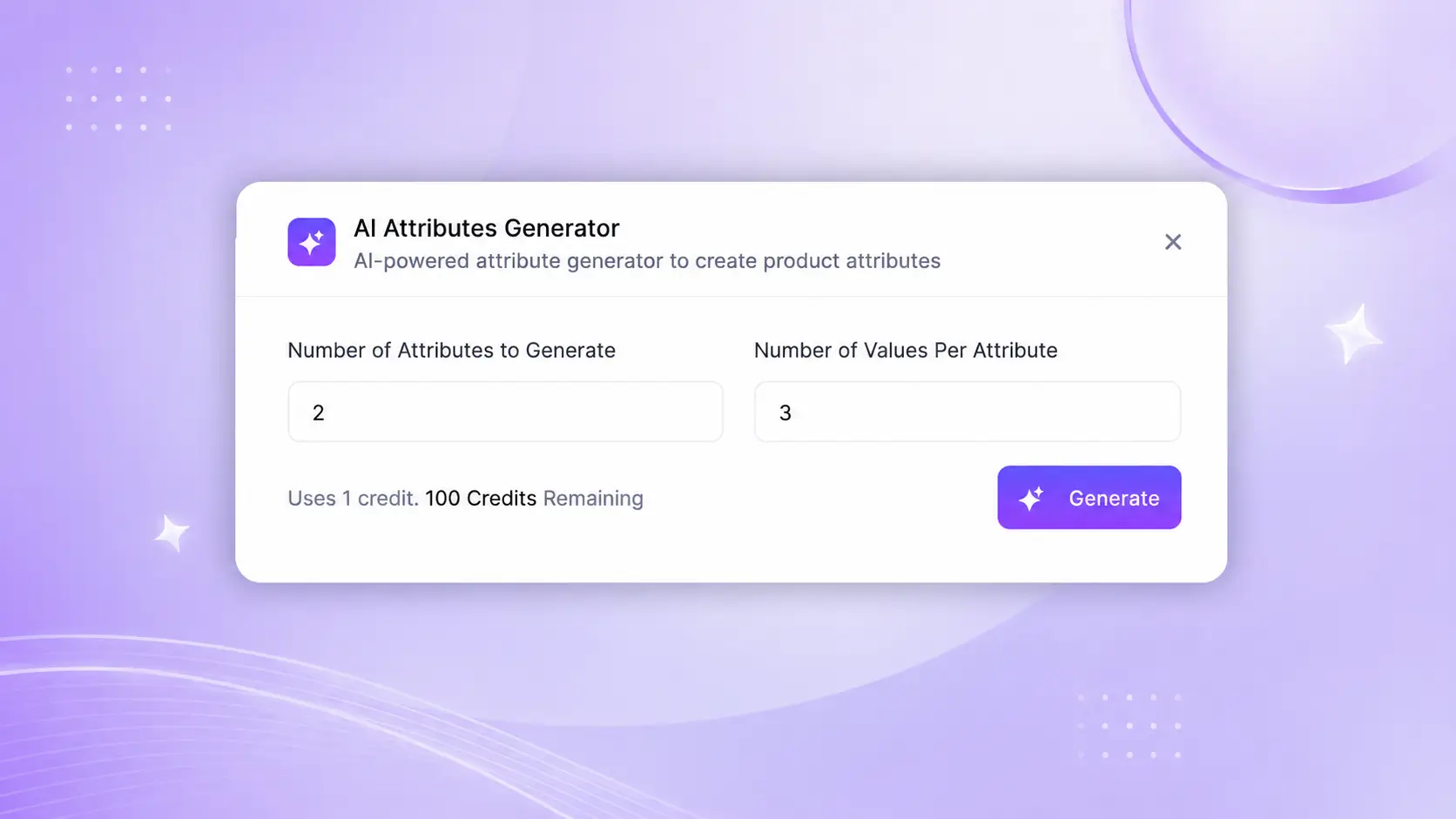
This should still be treated as assistance rather than authority. If an AI system incorrectly identifies a jacket as “waterproof” when it is only water-resistant, that error can affect both the customer experience and the accuracy of the catalog.
9. AI for Ecommerce Analytics
Ecommerce platforms collect large amounts of data, but store owners do not always have the time or analytics expertise to turn dashboards into useful answers.
Conversational analytics changes how merchants interact with that data.
Instead of manually configuring reports, a store owner could ask:
“Which five products generated the most revenue this month?”
Or:
“How did sales this week compare with last week?”
AI can translate a business question into a relevant data request and present the result in a more understandable format.
However, easier access to analytics does not eliminate the need for human judgment. The underlying question, date range, attribution model, or comparison may still be wrong, even if the AI presents the answer confidently.
10. AI Store Copilots and Back-Office Automation
A store copilot goes beyond explaining what is happening. It may also help merchants take action.
EasyCommerce’s Store Copilot currently allows administrators to ask questions about store information and perform actions using natural-language prompts.
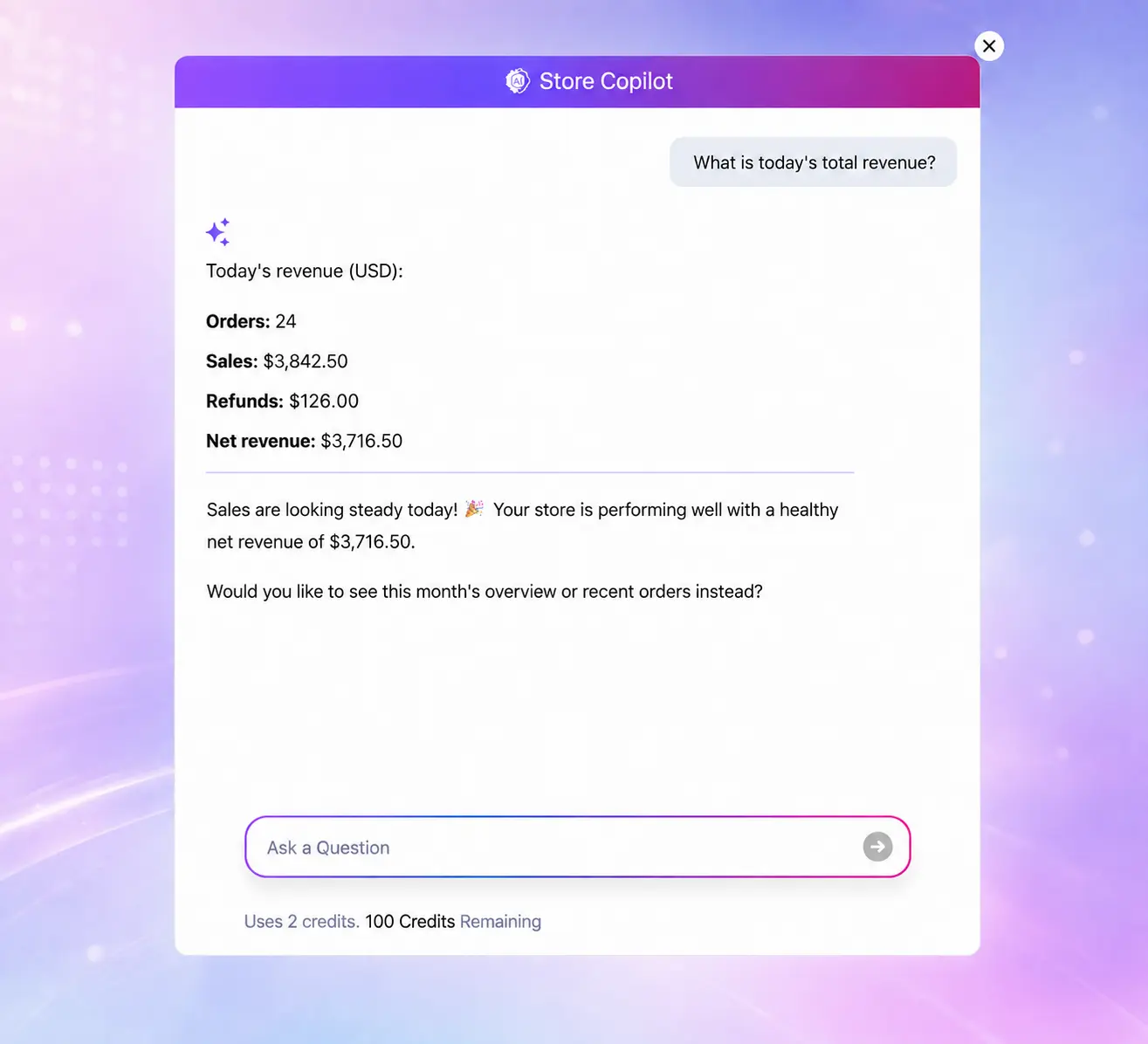
Its documented examples include analyzing products, creating coupons, adjusting inventory, managing orders, and issuing refunds. The system also records actions in an audit trail.
For example, an administrator might request:
“Create a 15% coupon for orders over $100 and expire it at the end of the month.”
The greater the control given to AI, the more important safeguards become. Permissions, authentication, confirmation steps, audit logs, and human oversight are especially important when an AI system can modify real store data.
11. AI in Customer Support
Ecommerce support includes many repetitive questions about:
- Product specifications
- Shipping
- Returns
- Order status
- Sizing
- Compatibility
- Payment issues
- Store policies
AI can answer straightforward questions quickly and route more complicated cases to the appropriate person.
This can extend support availability without requiring a human team to answer every basic question manually.
However, AI should not necessarily handle every support situation alone. Unusual refunds, damaged products, fraud concerns, account-security issues, policy exceptions, and sensitive complaints may require human judgment.
A reliable support system should know when to escalate rather than continue generating increasingly confident answers.
12. AI for Marketing and Advertising
AI is also being used throughout the ecommerce marketing funnel. Common applications include:
- Creating ad variations
- Drafting email content
- Segmenting audiences
- Analyzing campaign performance
- Personalizing messages
- Identifying customer patterns
- Generating creative concepts
One of the practical benefits is faster experimentation. A marketer can develop several initial concepts quickly, test them, and spend more time evaluating what actually works.
But easier content production can also create unnecessary volume. More ads, emails, and social posts do not automatically produce better marketing.
The stronger use of AI is to increase the quality and speed of meaningful experiments rather than simply producing more generic content.
How AI Changes the Ecommerce Customer Journey
AI becomes easier to understand when we map it across the customer journey.

Discovery: AI can influence which products a shopper discovers through search, advertising, recommendations, conversational interfaces, and personalized merchandising.
Consideration: Once the shopper is interested, AI can help answer questions, compare options, summarize product differences, and suggest products based on specific requirements.
Decision: Recommendations, product Q&A, review summaries, personalized information, and conversational assistance can help customers resolve uncertainty before buying.
Purchase: Agentic commerce brings AI closer to the transaction by allowing systems to prepare orders, calculate purchase details, and connect the shopper with checkout.
Retention: After purchase, AI can support customer service, personalized recommendations, re-engagement, and analysis of customer behavior.
The important point is that AI is not one stage of ecommerce. It is becoming a layer that can operate across the entire journey.
How to Start Using AI in Ecommerce: Step-by-step
The wrong starting point is that we need AI. Start with the business problem instead.
Step 1: Identify the Bottleneck
Look at where customers or employees are losing time. For example:
- Customers cannot find the right products.
- Writing descriptions takes too long.
- Support repeatedly answers the same questions.
- Catalog setup is slow.
- Reporting takes hours.
- Merchandising is difficult.
- Conversion is weak at a particular step.
Then decide whether AI is actually suited to that problem. If customers leave because shipping is too expensive, an AI chatbot probably is not the solution.
Step 2: Choose One High-Value AI Use Case
Do not deploy AI everywhere at once. Choose an area where you can clearly compare the before and after. Good starting points may include:
- Product-description drafting
- Product search
- Analytics
- Customer support
- Product imagery
- Catalog enrichment
For example, if creating product descriptions currently takes 20 minutes per product, measure whether an AI-assisted workflow reduces the time while maintaining accuracy.
If customers struggle with search, measure whether intelligent search improves search-to-product clicks and conversions.
Step 3: Improve Your Product Data
This is one of the least glamorous but most important parts of ecommerce AI. AI works better when the information underneath it is reliable. That means maintaining:
- Accurate product titles
- Categories
- Attributes
- Detailed descriptions
- Correct SKUs
- Current prices
- Current inventory
- Good-quality images
- Shipping information
- Product relationships
An AI assistant cannot reliably answer whether a laptop has 16 GB of RAM if that information is missing from your catalog.
Likewise, an agent cannot safely tell a shopper that a product is available if the inventory data is wrong. Improving your data may produce more long-term value than adding another AI tool.
Step 4: Choose AI Tools That Work With Your Ecommerce Stack
There are three broad ways to add AI.
- Standalone AI tools operate separately from the ecommerce platform. They can be excellent for writing, research, image work, and marketing, but you may need to move data between systems manually.
- Platform integrations connect external AI services with the store and can provide more direct access to catalog or customer information.
- Built-in ecommerce AI is integrated directly into the ecommerce platform, which can reduce configuration and make actions possible within existing workflows.
WordPress merchants using EasyCommerce, for example, currently have AI search, product-description generation, image generation and editing, attribute generation, a Shopping Agent, and Store Copilot integrated into the platform.
Its AI tools run through a managed EasyCommerce service rather than requiring merchants to configure separate OpenAI or other provider API keys. Merchants connect the store to an EasyCommerce account, and the features draw from a shared credit balance.
Whichever approach you choose, start small. Enable the feature, define what success means, test it with real products and customers, review failures, and expand only after you have evidence that it improves the workflow.
Should Every Ecommerce Business Use AI?
Probably in some capacity. But that does not mean every ecommerce store needs every AI feature. The right starting point depends on the business.
| Business situation | Good AI starting point |
| Small catalog | Content + support |
| Large catalog | Search + catalog management |
| High traffic | Personalization |
| Many support questions | Conversational AI |
| Data-heavy store | AI analytics |
| Lean team | Store copilot |
| Complex product discovery | Shopping agent |
A small store with 20 simple products probably does not need a sophisticated recommendation engine.
But the same business may benefit from an AI assistant that reduces support workload or helps create content.
A store with 50,000 products has different problems. Search quality, catalog enrichment, personalization, and automated data management may offer much greater value.
You should choose AI based on the bottleneck, not the trend.
What AI Still Cannot Replace in Ecommerce
AI can automate many ecommerce tasks, but it still cannot replace human judgment and expertise.
Human input remains important for:
- Product expertise
- Brand strategy
- Customer understanding
- Quality control
- Strategic decisions
- Customer relationships
AI can write a product description, analyze refund data, or create a marketing campaign. But humans still need to verify the information, understand the context, and decide whether the output is right for the business.
The best use of AI is to help ecommerce teams accomplish more without removing human judgment from the process.
The Future of AI in Ecommerce
The next step is moving from AI that assists with tasks to AI that can complete ecommerce actions.
This could include:
- AI shopping agents
- Conversational product discovery
- AI-assisted checkout
- Personalized shopping experiences
- Automated post-purchase support
Google’s Universal Commerce Protocol (UCP) is one example of this direction, designed to help AI agents and businesses interact across commerce activities such as product discovery, purchasing, and post-purchase support.
For merchants, this means stores may increasingly need to serve both human shoppers and AI agents shopping on their behalf.
Accurate product information, pricing, inventory, policies, and checkout systems will become even more important.
AI in Ecommerce Is Not Without Risks
AI can make ecommerce more efficient, but it also introduces new risks. The key areas to watch are:
- Incorrect AI outputs: AI can misunderstand products, policies, or customer questions. Important information should be based on reliable store data.
- Poor product data: Inaccurate inventory, missing specifications, or outdated information can lead AI to make the wrong recommendations or promises.
- Customer privacy: AI may access customer details, orders, and conversations. Only share the data the system actually needs.
- AI content at scale: Creating thousands of pages is easy, but creating thousands of useful pages is not. Use AI to improve content, not simply increase its volume.
- Misleading AI images: Product visuals should accurately represent the real product, including its size, color, materials, and included items.
- Over-automated support: Complex issues such as disputes, damaged orders, and unusual requests may still require human support.
- Too much AI control: The more actions an AI agent can take, the more important permissions, confirmations, and audit trails become.
The goal is not to avoid AI. It is to use AI where it adds value while keeping humans in control of high-impact decisions.
Final Thoughts
The real shift in ecommerce AI is not just faster content creation. AI is becoming capable of understanding shoppers, using store data, and taking action.
You do not need to automate everything. Start with one real problem, use AI to solve it, measure the result, and expand what works.
For WordPress stores, tools like EasyCommerce are bringing AI directly into ecommerce through smart search, product creation, conversational shopping, and AI-powered store management.
The goal is not more automation. It is a better, more useful store.
Frequently Asked Questions About AI in Ecommerce
AI in ecommerce uses artificial intelligence to improve shopping and store operations, including search, recommendations, content creation, customer support, and analytics.
Examples include AI product recommendations, natural-language search, shopping chatbots, AI-generated product descriptions, and AI shopping agents.
AI can reduce repetitive work, improve product discovery, personalize shopping experiences, speed up content creation, and simplify data analysis.
AI can help increase sales by improving search, recommendations, customer support, merchandising, and checkout. However, results depend on the use case and should be measured through metrics such as conversion rate and average order value.
You can add AI through plugins, third-party services, or ecommerce platforms with built-in AI. EasyCommerce includes AI Smart Search, product and image generation, attribute generation, an AI Shopping Agent, and Store Copilot.



Leave a Reply